
Spokane bishop recovering from double lung transplant after years on surgery waitlist

The Rt. Rev. Gretchen Rehberg was consecrated as bishop of the Diocese of Spokane in March 2017. She had continued to travel the diocese while waiting for a double lung transplant to alleviate pulmonary fibrosis. Photo: Richard Chan
[Episcopal News Service] Spokane Bishop Gretchen Rehberg had waited a long time for this moment. On March 14, she sent a message to her diocese in eastern Washington and northern Idaho saying the wait was over: She had received the call and was at the University of Washington Hospital in Seattle awaiting a double lung transplant.
Rehberg, 61, has suffered for years from pulmonary fibrosis, a condition possibly tied to her time in 2001 as a seminarian in New York near Ground Zero in the aftermath of the 9/11 attacks. In recent years, as her condition worsened, her doctors suggested she pursue a transplant surgery, for which she has been on the waitlist since early 2023.
When the call finally came, Rehberg focused her letter to the diocese on “the plan already in place” for interim diocesan leadership, with assistance from the Rev. Susan Cleveley, canon to the ordinary. “In this time of both uncertainty and hope, let us all remember that the diocese is in good hands, that we follow Jesus, and that God has blessed us and will continue to walk with us in our journey,” Rehberg said.
Several hours later, the diocese notified its members that Rehberg’s surgery was complete, and she was recovering in the ICU. “We give thanks for the skilled surgeons, doctors, and nurses who are caring for her, and for the many prayers that have been offered on her behalf across the diocese,” the update said. “Recovery from transplant surgery will take time, and Bishop Gretchen will remain unavailable while she rests and heals.”
Members of the Diocese of Spokane have known about Rehberg’s lung condition from the start. Her diagnosis was included in the materials she submitted to be considered for bishop. She was elected in October 2016 and consecrated the following March.
Since then, her pulmonary fibrosis has slowly worsened, and in 2022, she suffered a flare-up that sharply decreased her lung capacity. If lungs are like balloons, hers can’t fully inflate because the tissue is scarred. Regular tests previously measured her lung capacity at 50%. After the flare-up, it dropped to 40% capacity.
The bishop once enjoyed running and hiking but hasn’t been capable of either for years. Higher elevations could complicate Rehberg’s travel. Holy Trinity Episcopal Church, for example, is at about 3,400 feet in Grangeville, Idaho.
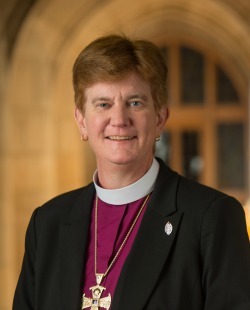
The Rt. Rev. Gretchen Rehberg is bishop of the Diocese of Spokane.
While she waited on the transplant list, she told Episcopal News Service in a May 2023 interview that she resisted any thought of easing her schedule because of her disability. “I absolutely love what I do. I can’t imagine not doing it,” she said. “I firmly believe I’m called by God to do this work.”
She explained in that interview that after surgery and two to three weeks of inpatient care, she expected to live near the hospital in Seattle for an additional three months to receive follow-up care. Her work as bishop would continue, by Zoom at first and eventually in person.
Rehberg will have to take medication for the rest of her life to decrease the odds that her body will reject the new lungs. Transplant rejection and side effects from the medication are the main long-term risks for lung transplant patients. Nearly 90% of patients are still alive one year after a lung transplant. The current five-year survival rate is 60%.
“Our mission and ministry continue, and while I ask that you keep me in your prayers, please know that I will also be keeping all of the diocese in mine,” Rehberg said in her March 14 message before the surgery.
Her family is posting additional updates to a page on CaringBridge.
– David Paulsen is a senior reporter and editor for Episcopal News Service based in Wisconsin. He can be reached at dpaulsen@episcopalchurch.org.