
Executive Council authorizes sale negotiations with potential buyer of church’s NYC headquarters
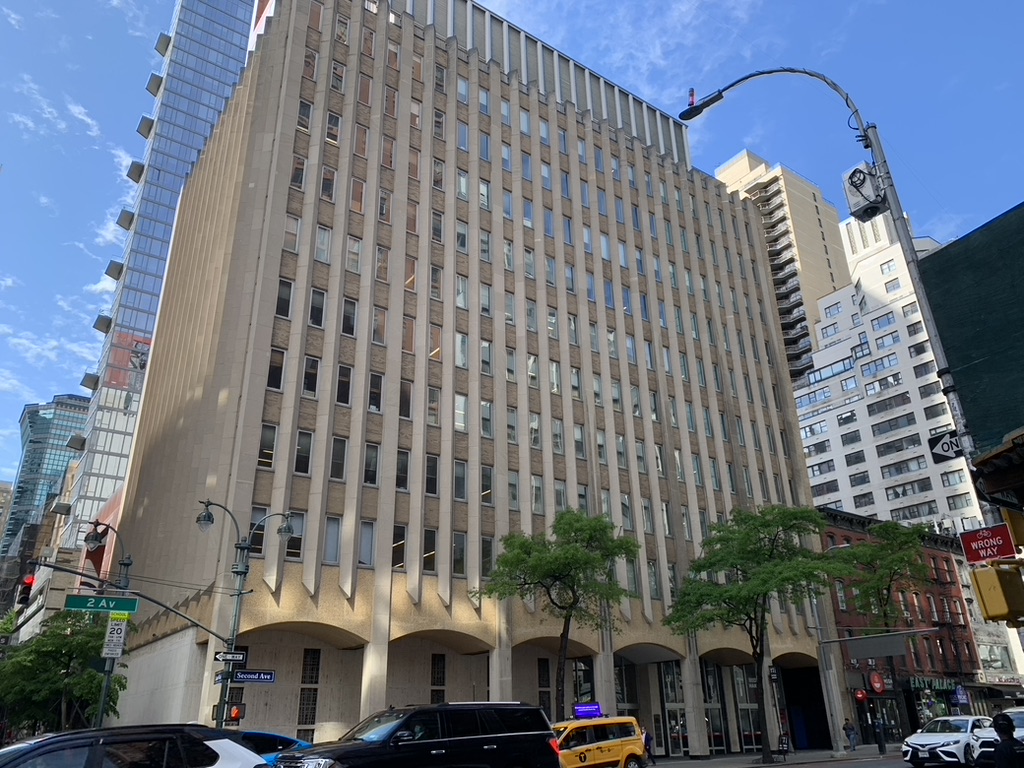
The headquarters of The Episcopal Church at 815 Second Ave. in New York, New York. Photo: Egan Millard/Episcopal News Service
[Episcopal News Service] The Episcopal Church has found a prospective buyer for its 12-story office building in New York, New York, and is finalizing a tentative plan to move out of the longtime church headquarters, based on sale negotiations authorized on Oct. 19 by Executive Council, the church’s governing body between General Conventions.
The buyer has not been named and the price has not been revealed, but the impending sale, if completed, would mark the culmination of decades of discussions about whether to maintain the current denominational headquarters or downsize in another location.
The Episcopal Church Center in Midtown Manhattan is commonly referred to as “815” because of its street address, 815 Second Ave. A quarter of the proceeds from its sale will be set aside to pay for temporary offices in Manhattan and, eventually, to “fund costs associated with a new permanent location for the Church Center in a metropolitan area or state to be determined,” according to the resolution adopted by Executive Council.
The rest of the proceeds, 75%, is to be placed in a new trust fund that will distribute grants for church planting, redevelopment and revitalization as part of Presiding Bishop Sean Rowe’s strategic framework for the church’s future, which also was adopted by Executive Council during a one-day meeting in the headquarters building.
“I think it’s really the opportunity to put our money where our mouth is, and say we’re going to repurpose an asset that we have that has been given to us as a legacy, and we’re going to use it to plant seeds for the future,” Rowe told Episcopal News Service after Executive Council’s votes.
“This is essentially saying we’re going to sell the house in order to plant new churches and revitalize our congregations, and I think it sends a great message to the church.”
The Episcopal Church Center includes 146,000 square feet of space, but in recent years, much of the churchwide staff has worked remotely in locations across the United States and Europe. Less than half the building is now occupied by church operations or affiliated organizations.
In 2012, bishops and deputies at General Convention voted in favor of pursuing a new headquarters. The resolution said simply: “It is the will of this Convention to move the Church Center headquarters away from the Church Center building at 815 2nd Avenue, New York City.”
Despite the 2012 resolution, planning for such a relocation never got off the ground. Chief Financial Officer Christopher Lacovara researched what it has cost the church to keep the building in the years since that vote.
“If we had sold 815 Second Ave. following the 2012 General Convention resolution, invested the proceeds in the endowment and avoided the losses incurred by operating the building since then, we would now have $85 million in additional funds,” Lacovara said in a written statement to ENS.
In June 2026, Executive Council voted to hire New York-based Denham Wolf Real Estate Services to market the 63-year-old building for a possible sale. “In July through September 2026, the DFMS conducted a broad marketing process and received numerous offers to sell the building for cash,” the council said in documentation supporting the vote, referring to the church’s corporate entity, the Domestic and Foreign Missionary Society.
Under the pending sale, the church would have access to one floor of the current headquarters through 2027 while it arranges to relocate to new offices.
House of Deputies President Julia Ayala Harris, in her opening remarks to Executive Council, said the building’s sale raises the question, “what are we called to sustain?”
“Our faithfulness will not be measured by whether we preserved a certain address, but by whether our decisions have enabled the church to serve God’s Mission, and that question … goes well beyond the matter of this building,” Ayala Harris said.